What InfraPoint actually does
Every claim on this page describes a shipped feature, and every screenshot is the real application.
Change enablement that plans before it approves
Opening planning on a change generates owned work instead of empty text fields: an implementation plan and rollback plan routed to the system's administrator, a test plan for the test owner, a risk assessment, and a per-dependent impact assessment that asks, for every system depending on the one you are changing, whether it is affected and how.
Approval waits for all of it. High and critical risk changes additionally collect confirmations from the owners of affected dependent systems, and generate team check-ins before and after implementation. Verification is blocked while any critical test case fails, and failed non-critical tests are filed as known errors automatically.
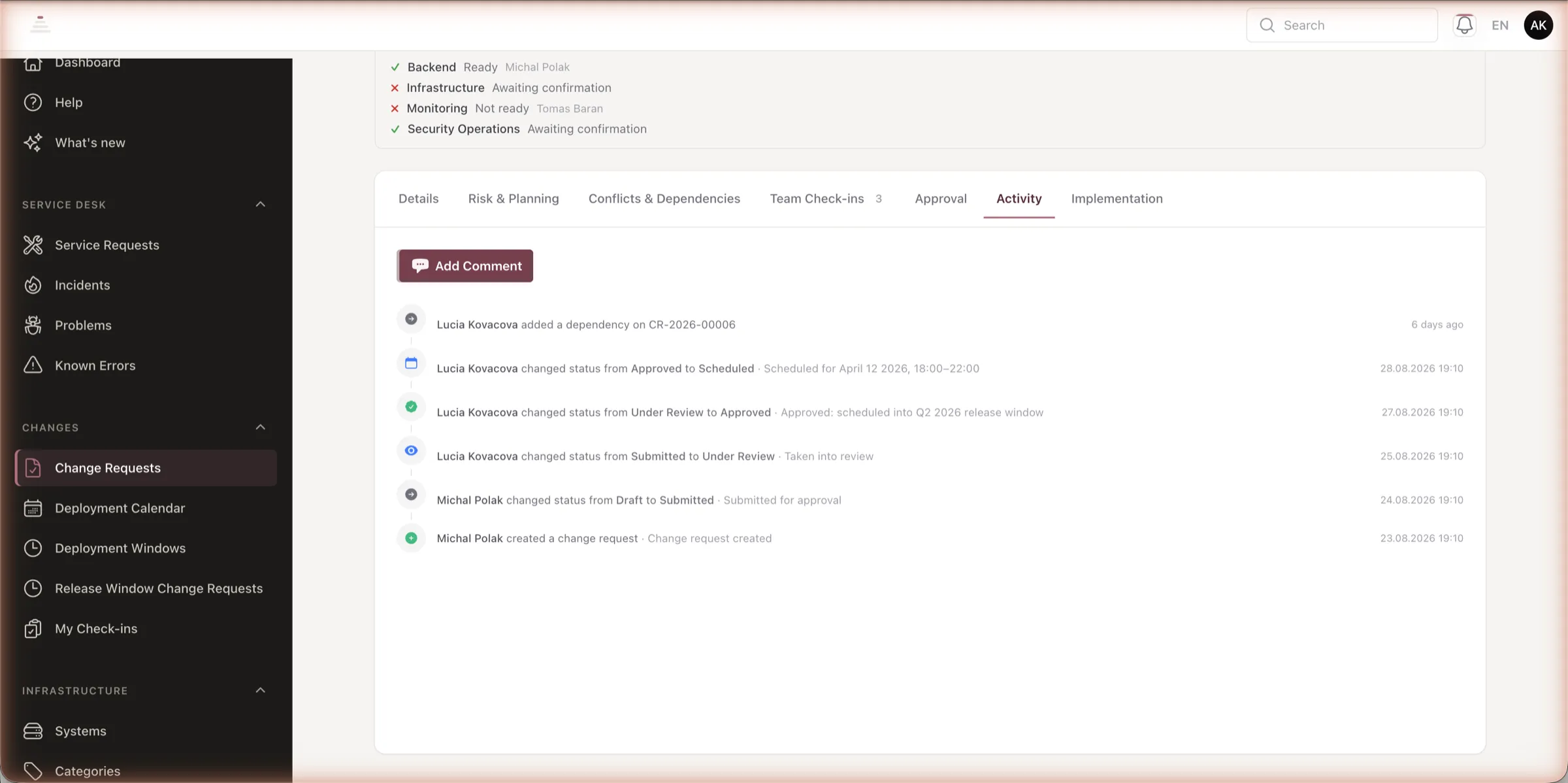
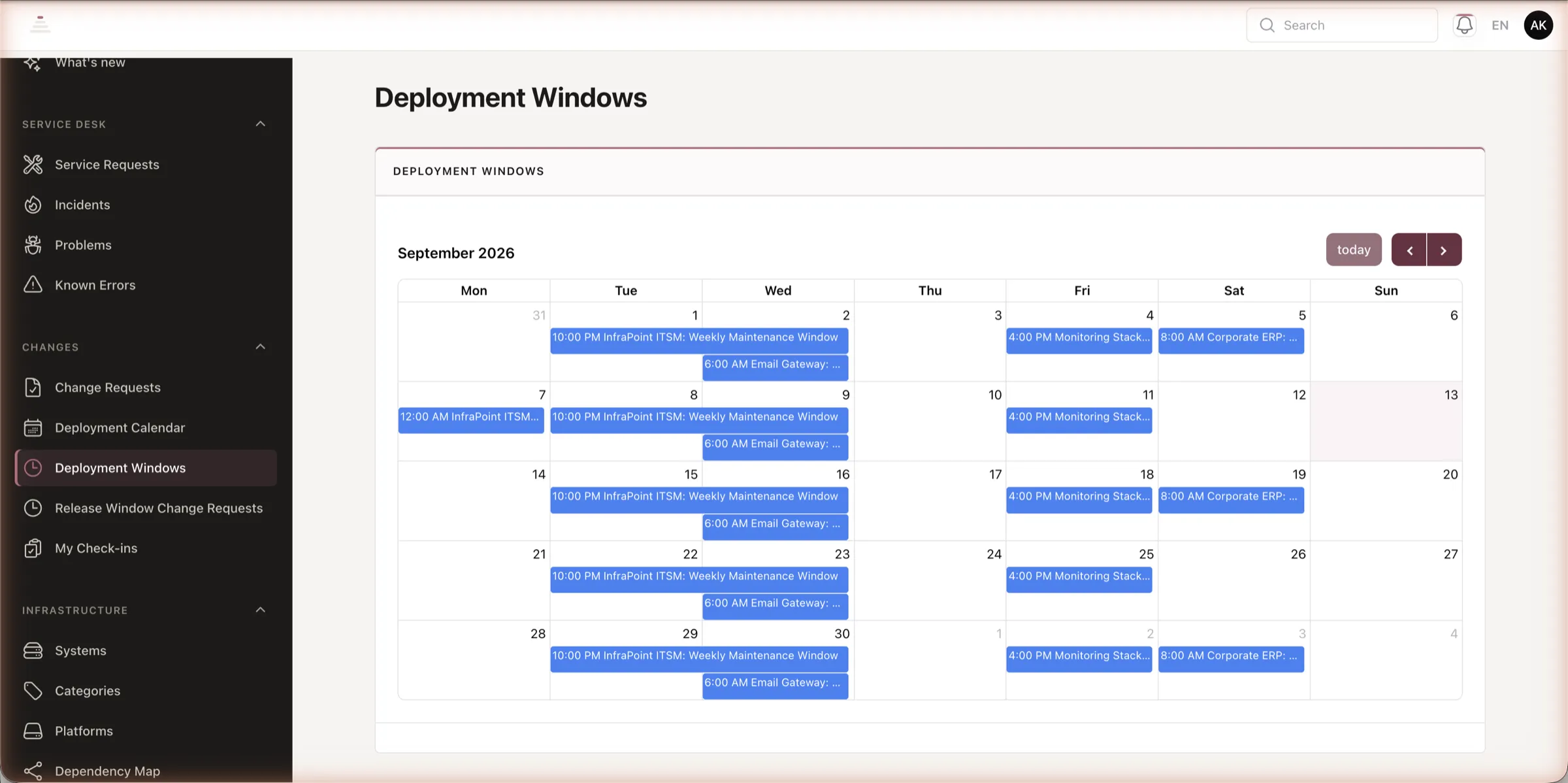
- Planning cards routed to the roles that own them
- Per-dependent impact assessment before submission
- Conflict detection across overlapping changes
- Release windows with in-window scheduling checks
- Check-ins gating risky changes, with a logged override
- Test cases whose failures block verification
Incidents with a truthful clock
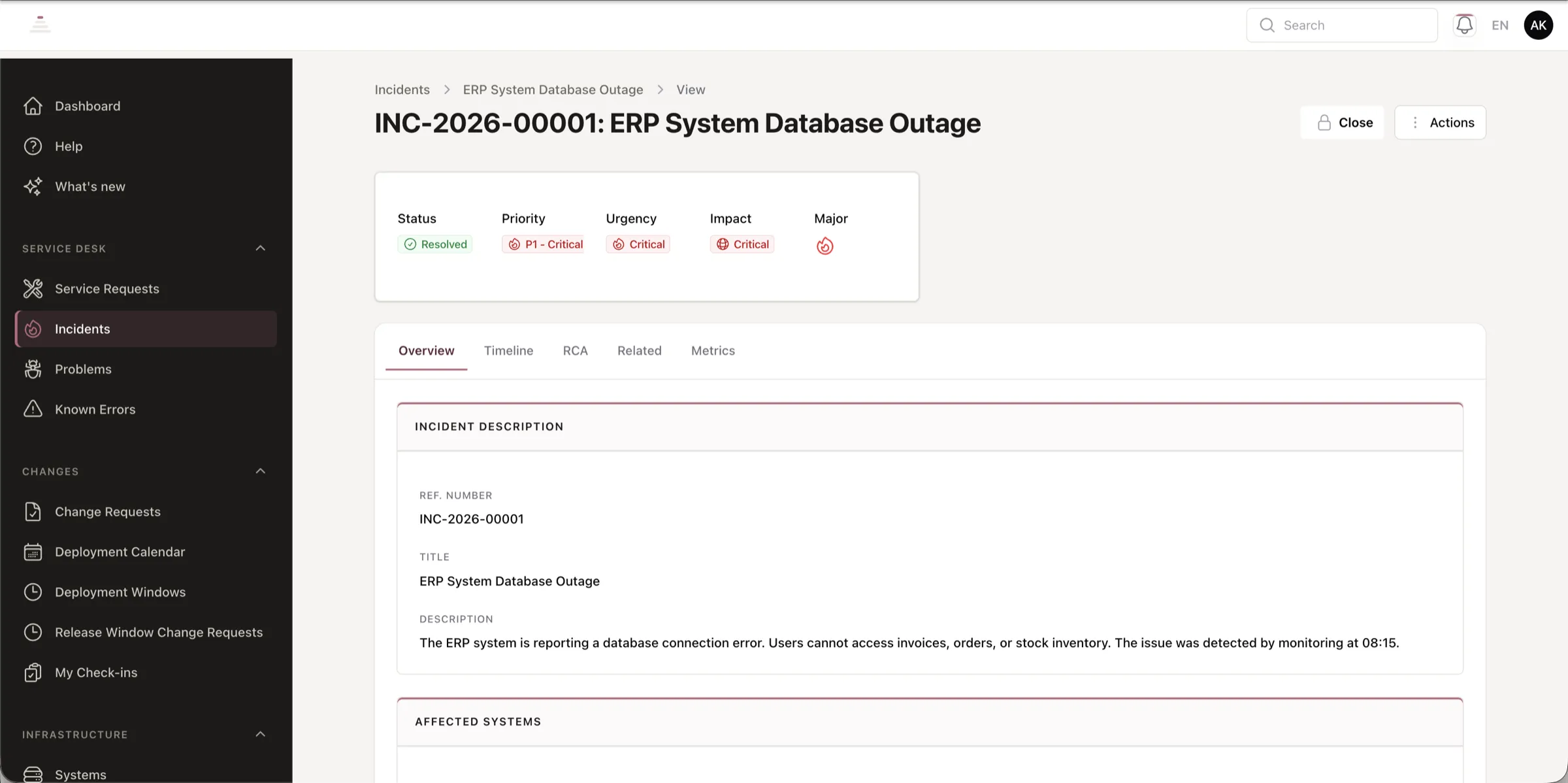
Priority is computed from urgency and impact, not typed in. Every incident carries a timeline of status changes, updates, and SLA events from first report to close, and major incidents can be declared and tracked as such.
When a supplier has to fix it, escalate to them: the internal SLA clock pauses, the supplier's contractual clock starts, and both are reported honestly. Closing an incident with a workaround spawns a problem so the real cause is not forgotten.
- Priority from an urgency and impact matrix
- Supplier escalation that pauses the internal SLA
- Full timeline of every action and state change
Service requests that follow a workflow, not an inbox
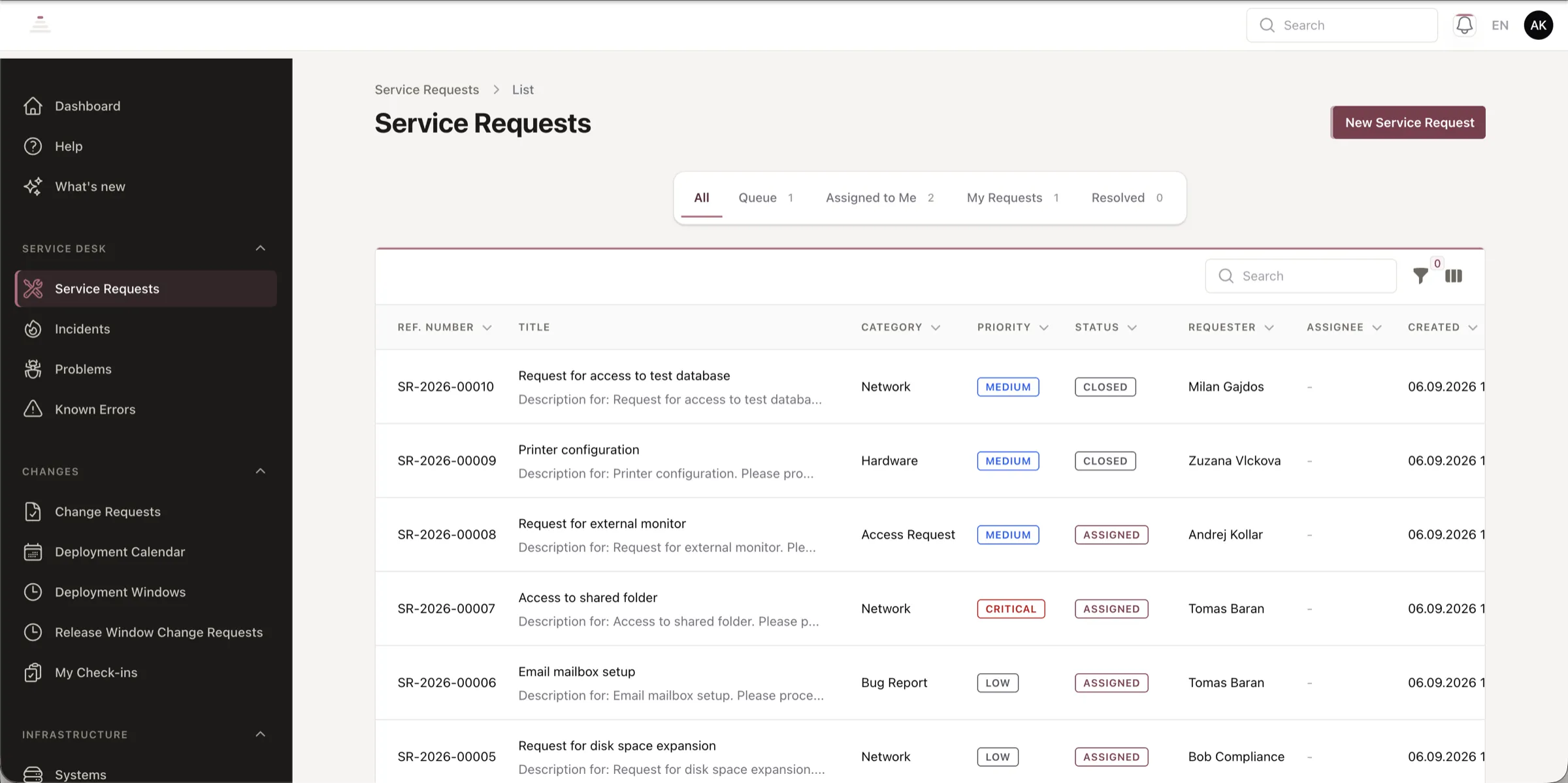
Each request type moves through defined workflow steps mapped to the teams that handle them, with checklists that gate progression. Requesters see where their request stands instead of asking.
Resolved requests close themselves overnight, and fulfilment is tracked against the SLA like everything else.
- Workflow steps per request type, mapped to teams
- Checklists that gate step completion
- SLA-tracked fulfilment and CSV export
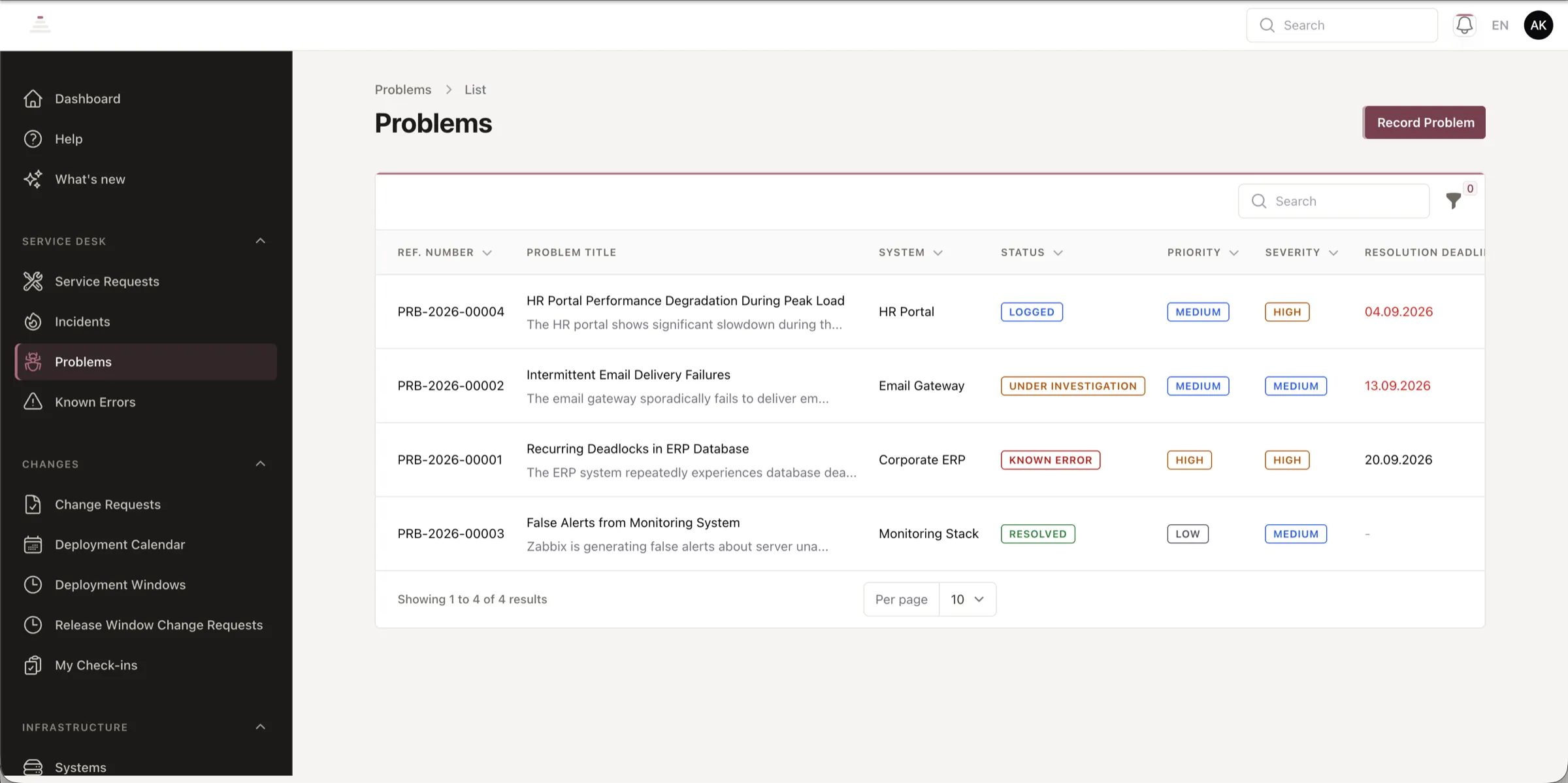
Problems, known errors, and the end of repeat incidents
Recurring incidents become problem records with documented root cause analysis. Workarounds live in a known error database that responders can search while the underlying fix is in progress.
The pipeline feeds itself: closing an incident with a workaround spawns a problem, and a failed non-critical test on a change files a known error linked back to that change.
- Root cause analysis on problem records
- Known error database with documented workarounds
- Automatic problem creation from workaround closures
A system inventory that knows what breaks what
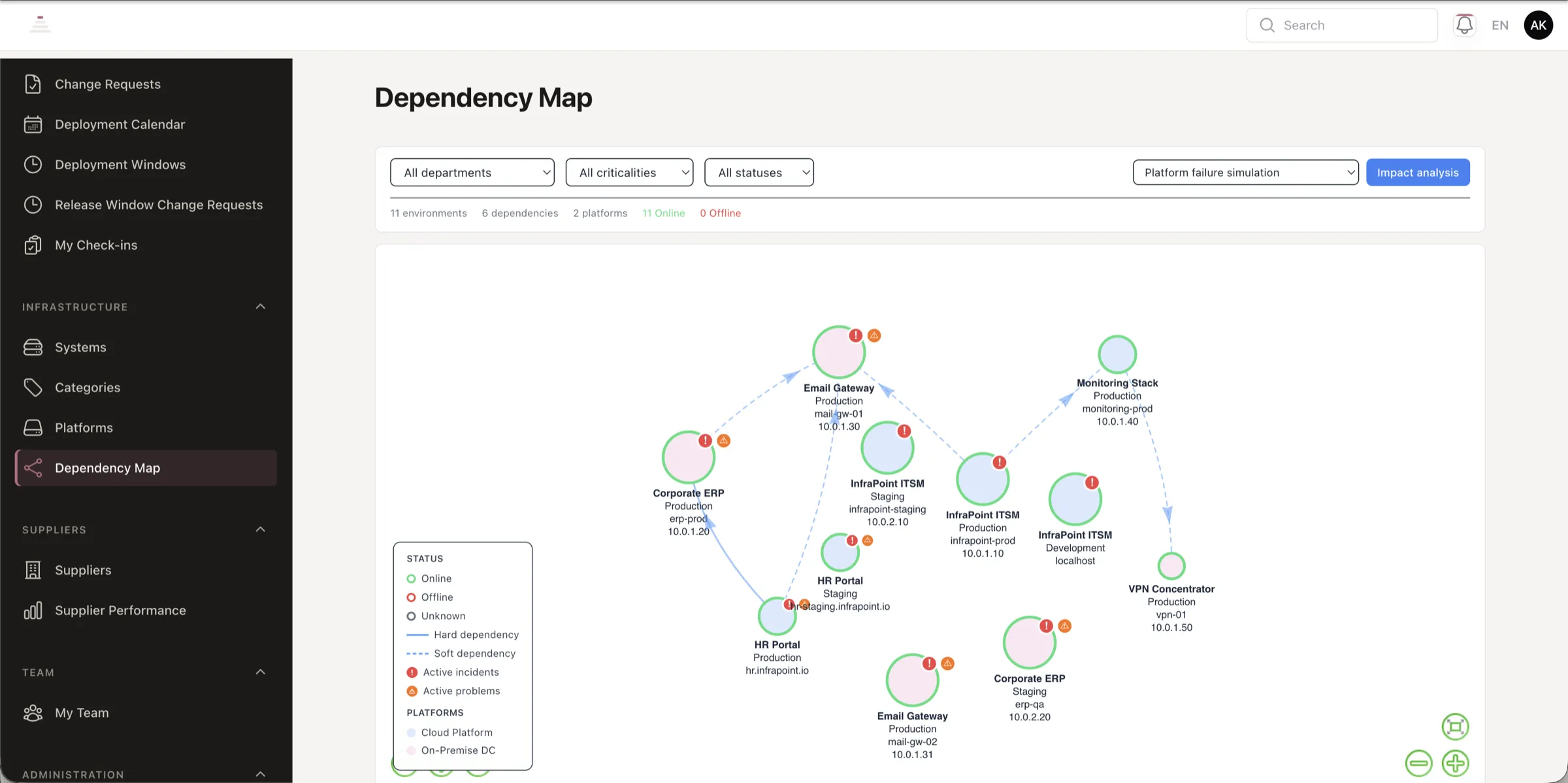
Systems carry owners, criticality, and separate dev, test, and production environments hosted on tracked platforms. Dependencies between them form an interactive map with impact analysis, so you see the blast radius before a change, not after an outage.
Environment health is checked over HTTP every five minutes, with notifications when something goes down and when it recovers.
- Interactive dependency graph with impact analysis
- Owners, criticality, and environments per system
- Health checks every five minutes with down and recovery alerts
An SLA engine with two honest clocks
Policies define response and resolution targets per record type and priority. Internal targets and supplier contract targets run as separate clocks: escalating to a supplier pauses yours and starts theirs from the contract's hours. A sweep flags anything at 80 percent of its target, so you hear about risk before the breach.
- Targets per record type and priority
- Internal and supplier clocks tracked separately
- At-risk alerts before the deadline, breach flags after
Suppliers held to their contracts
Supplier records hold contacts, contracts, and the response and resolution hours those contracts promise. Escalations are measured against them, and supplier performance reviews build the record you need at renewal time.
- Contracts with their own SLA hours
- Escalations measured against contract targets
- Performance reviews per supplier
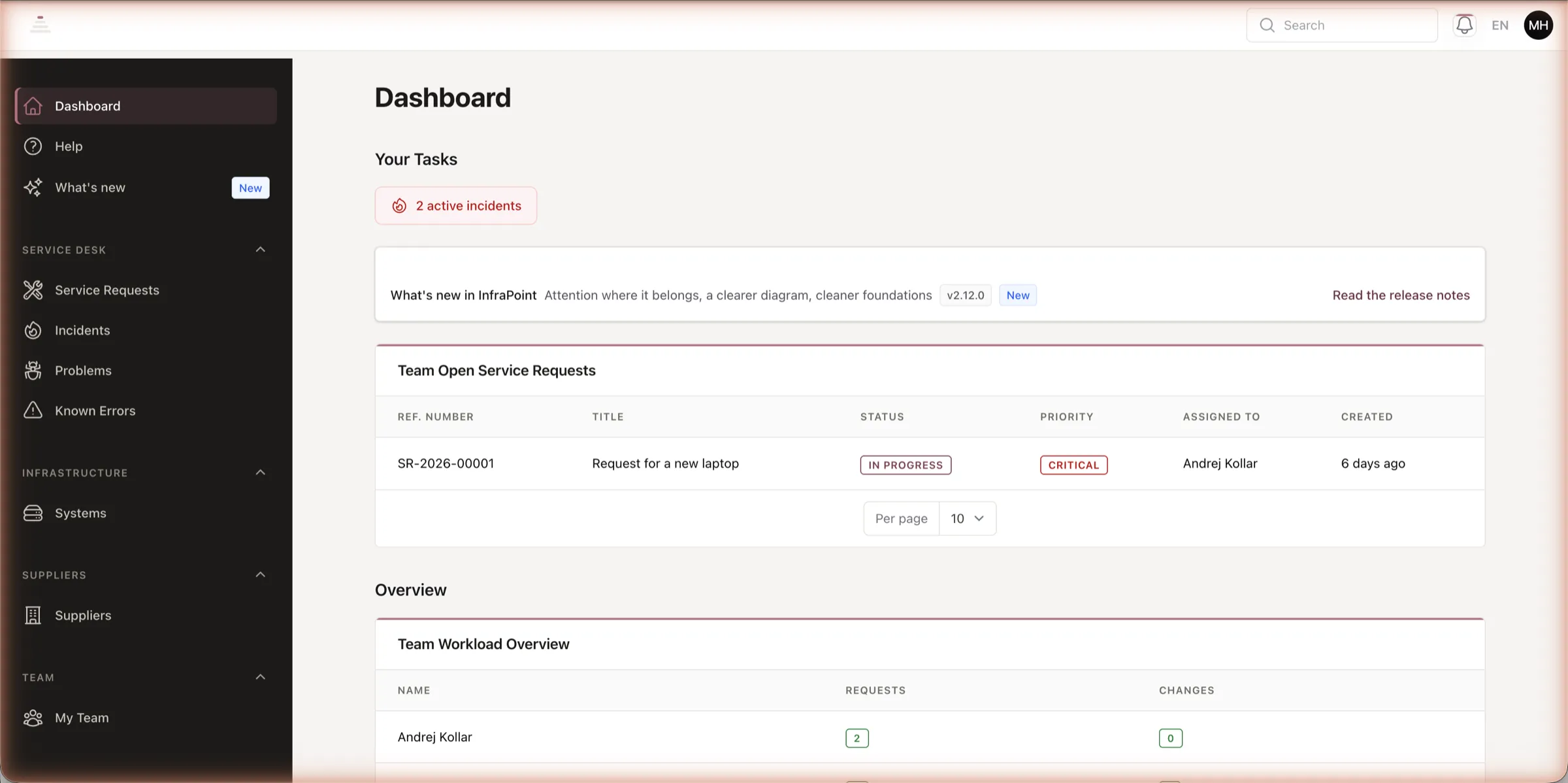
Role-based dashboards and a complete audit trail
A department manager opens InfraPoint to workload and SLA compliance; a technician opens it to their queue. Dashboards are assembled per role, and the What's New page keeps everyone current on what changed in the platform.
Underneath it all, the activity log records every state change with actor and timestamp, per record and across the system.
- Dashboards matched to each role's actual job
- Per-record activity timelines
- System-wide audit log with actor and timestamp
Cloud with real isolation, or fully on-premise
In the cloud, every customer gets a physically separate database rather than rows in a shared one. If your policies require it, install InfraPoint on your own infrastructure instead: the on-premise mode is the same product with the same features, and your data never leaves your network. The interface ships in Slovak and English, switchable per user.
- Database-per-tenant isolation in SaaS mode
- Self-hosted on-premise mode, feature-identical
- Built in the EU, designed around GDPR
- Bilingual Slovak and English interface
See it with your own data.
14 days on the Professional tier, no credit card. Set up your systems and run a change through the gates.